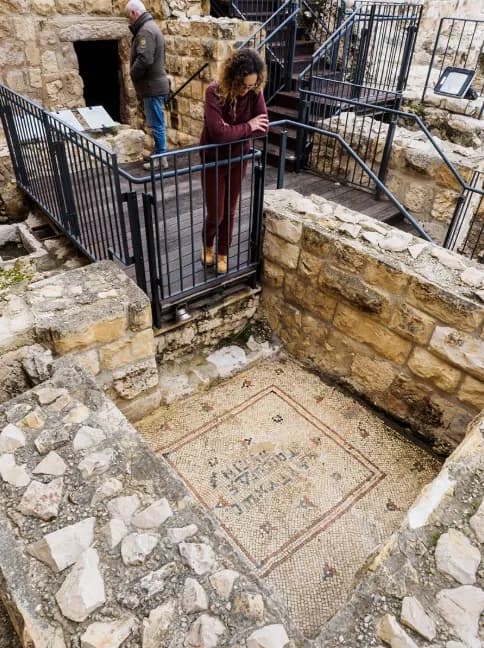
JERUSALEM — Archaeologists have uncovered a large Second Temple-period purification complex near the Temple Mount, providing new evidence of how Jewish pilgrims may have prepared before entering the sacred precinct nearly 2,000 years ago.
The complex was discovered at the Ophel archaeological site, immediately south of the Temple Mount, during excavations directed by Prof. Uzi Leibner and Prof. Orit Peleg-Barkat of the Hebrew University of Jerusalem’s Institute of Archaeology.
Covering approximately 280 square meters, the site includes a large central plastered pool, three ritual baths known as mikvaot, a paved courtyard and an extensive system of water and drainage channels.
The complex is located near the ancient Triple Gate, one of the principal entrances used to reach the Temple Mount during the Second Temple period. Archaeologists believe its location and size indicate that it may have served Jewish pilgrims who needed to undergo ritual purification before ascending to the Temple.
The main complex dates to the early first century CE. One of the mikvaot survived to its full height of approximately 4.2 meters and retains its vaulted stone roof and a shaft used to supply water.
Researchers also discovered unusual drain holes in the floors of the ritual baths. The feature suggests the water could be emptied and replaced and raises the possibility that the complex received running water, potentially from an aqueduct supplying the Temple Mount.
Excavations beneath the monumental complex revealed evidence of an even earlier public purification facility, including a large mikveh probably dating to the first century BCE. The discovery suggests ritual-purification activity took place at this location over an extended period.
Archaeologists also uncovered dozens of coins associated with the First Jewish Revolt against Rome and evidence of destruction dating to 70 CE, when Roman forces destroyed Jerusalem and the Second Temple.
The discovery provides additional archaeological context for understanding Jewish pilgrimage during the Second Temple period. The Torah instructed Israelites to appear before the Lord during the pilgrimage festivals of Passover, Shavuot and Sukkot, while ritual purity played an important role in Jewish religious life.
The newly uncovered complex offers a physical glimpse into how those practices may have been carried out by pilgrims approaching the Temple nearly two millennia ago.
Reference:
jpost/archaeology/article-909482